Friday, June 26, 2009
Friends of Felton wins Carbon Challenge!

Monday, June 22, 2009
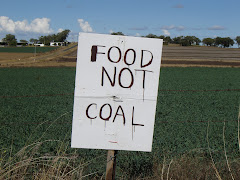
Windmills and solar panels instead of dirty “Clean Coal”
FRIENDS OF FELTON Inc.
Friends of Felton today welcomed the release of the Queensland Government’s Renewable Energy Plan and offered Felton as a potential renewable energy site providing the Government bans coal mining development in the area.
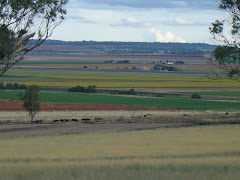
The Felton Valley, 30km southwest of Toowoomba, is under threat from a proposal by Ambre Energy to build a 12.8 million t/yr open-cut coal mine, a petrochemical plant to convert the coal into liquid fuel, and a power station.
Spokesman Rob McCreath said “We know that the so-called ‘Felton Clean Coal Project’ would destroy and contaminate a large area of prime farmland with disastrous consequences for the environment and the local community with no net gain in employment. On the other hand, renewable energy production would co-exist easily with top quality food production and provide a net gain in employment without harming the environment or the community.”
Premier Anna Bligh said yesterday that “climate change is one of the great challenges of our age”.
Friends of Felton stands ready to play its part in meeting that challenge.
ENDS
www.friendsoffelton.blogspot.com
Saturday, June 6, 2009
Call an ambulance
http://blogs.abc.net.au/queensland/2009/06/agriculture-v-m.html?program=612_evenings
Incidentally, if you listen to the recording you will hear Michael Roche say "the farmers at Felton are selling". This is very misleading. The truth is that Ambre Energy has bought 1 farm of 96ha. The area covered by Ambre's proposed project is approx 2800ha, and the first stage covers 355ha. Besides, according to the law, ownership of the land does not in any way influence the granting of a Mining Lease. It's a pity the Minister wasn't there on Thursday night to put the record straight.
If he had been there, no doubt he'd have brought out the Govt's favourite line -
"Agriculture and mining have co-existed for over 100 years, and there's no reason why they can't continue to co-exist".
The fact is that coal mining destroys farmland, pollutes rivers, and drains underground aquifers. When the coal is burned, it produces greenhouse gases which accelerate global warming, giving us more frequent and severe droughts.
Mining co-exists with agriculture as cancer lives in the body, not noticed at first, but gradually eating away until the vital organs are threatened. It's time to call an ambulance!
Thursday, May 21, 2009
Nobody's fooled
"The mine will be developed in two stages; the initial stage will involve the extraction of 800,000 tpa with the second stage expanding to 3.8 Mtpa."
Read the whole thing here - http://www.ambreenergy.com/_uploads/22256IAS.pdf
It seems Ambre have one story for the EPA and Felton locals, and another for potential investors. Have a look at the program for a briefing given by Ambre Energy to the Mining & Energy Services Council of Australia in Brisbane last week -
BRISBANE BRIEFING
Thursday 14 May 2009
Ambre Energy - Felton Mine and Dimethyl Ether Pilot Plant Project
Speaker: Steve Messiter – Director Project Development, Ambre Energy
Ambre Energy Limited is proposing to build and operate a world-class clean coal gasification plant near Felton,
approximately 30km south west of Toowoomba and 10km south east of Pittsworth producing a hydrogen-rich
synthesis gas for the following purposes:
· Production of 2.8 million tonnes per year of dimethyl ether (DME);
· Generation of 650 MW of electricity using an Integrated Gasification Combined Cycle (IGCC) system.
The initial phase of the project will be a Demonstration Stage (scheduled for commissioning in 2011) involving
an 800,000 tonnes per year coal mine and a coal gasifier capable of producing 1,980 tonnes per day of a
hydrogen-rich syngas.
At final stage the open cut coal mine will provide 12.8 million tonnes of coal per year to the gasification plant.
The Project will also capture CO2 (1,339 tonnes per day at demonstration stage) for potential enhanced oil
recovery and geosequestration, produce by-products such as nitrogen for fertilizer production, and provide the
essential inputs for potential downstream olefins/plastics manufacturing facilities.
MESCA is Your Mining & Energy Industry Network
Program
3:45pm Registration
4:10pm Welcoming Address
4:20pm Major Sponsor’s Presentation
4:30pm Steve Messiter
Director Project Development , Ambre Energy
5:15pm Networking and refreshments
Details
Date: Thursday 14 May 2009
Venue: Hillstone St Lucia (St Lucia Golf Course)
Carawa St, St Lucia
Parking: Free onsite
Cost: MESCA Members $44.00 (inc GST)
$88.00 (2-4 Members) (inc GST)
Non Members $176.00 per person
Unfortunately, Friends of Felton couldn't afford the entry fee, but our spy behind the bar tells us the grand plan is little changed from Ambre's Initial Advice Statement (July08), available here in 2 parts -
http://www.scribd.com/doc/10841606/Ambre-Energy-Initial-Advice-Statement-2872008-Part-1
http://www.scribd.com/doc/10841900/Ambre-Energy-Initial-Advice-Statement-2872008-Part-2
Readers might also be interested in this critique from Dr Philip Machanick, University of Qld -
http://www.scribd.com/doc/11685961/Ambre-Felton-2008-critique
Thursday, May 14, 2009
Response from Mines Minister & Ambre Energy
Steve GrayMay 12, 2009
Approval of an open-cut coal mine on the Darling Downs would provide no financial benefit to Queensland taxpayers, say farmers whose land is threatened.
Farmers have legal advice indicating that Ambre Energy would not have to pay any royalties on the coal it intends to mine.
Ambre Energy plans to build a 12.8 million tonne a year open-cut coal mine, a petrochemical plant to convert the coal into liquid fuel, and a power station in the Felton Valley, 30km southwest of Toowoomba.
Local farmers and the community, who have formed the Friends of Felton, say the mine would destroy some of the finest agricultural land in Australia and have negative social and environmental impacts.
Spokesman Rob McCreath said the group had been advised that no royalties would be payable to the state, meaning the mine would have no direct economic benefit to taxpayers.
"Legal advice obtained by Friends of Felton indicates that royalties payable on any coal mined at Felton would not be payable to the Queensland government," Mr McCreath said.
He said a section of Queensland mining laws stated that "coal on or below the surface of the land is the property of the crown, except where that land was alienated in fee simple by the crown before 1 March, 1910".
"Farms at Felton were granted freehold title long before 1910," Mr McCreath said.
Asked if that was a correct interpretation of the law, Mines Minister Stephen Robertson said it was too early to discuss royalties.
"We first need to establish if there is going to be a mine at all before royalties are discussed," Mr Robertson said.
"All new mines must first meet the Queensland government's statutory requirements, particularly in relation to environmental standards, before any approval is granted.
"The public interest test will balance a range of considerations including environmental, economical and social impacts across the community."
Mr Robertson said the proposal would not go ahead unless it was in the best interests of the people of Queensland.
"Given the assessment process is still ongoing, it is far too early to make that decision."
Mr McCreath told AAP the project "clearly fails the public interest test".
A spokesman for Ambre Energy, Neil McGregor, said royalties would be paid on the coal, although in a small number of cases royalties could go to the landholder rather than the state.
"We won't know that until we investigate individual title documents," Mr McGregor said.
© 2009 AAP
Tuesday, May 12, 2009
Government would gain no royalties from a Felton coal mine

Government would gain no royalties from a Felton coal mine
The Felton Valley, 30km southwest of Toowoomba, Qld, is under threat from a proposal by Ambre Energy to build a 12.8 million t/yr open-cut coal mine, a petrochemical plant to convert the coal into liquid fuel, and a power station.
Legal advice obtained by Friends of Felton indicates that royalties payable on any coal mined at Felton would not be payable to the Queensland Government.
Section 8 (2) (b) of the Qld Mineral & Resources Act 1989 states –
“Coal on or below the surface of the land is the property of the Crown except where that land was alienated in fee simple by the Crown before 1 March 1910……”
Farms at Felton were granted freehold title long before 1910.
Spokesman Rob McCreath said- “The so-called Felton Clean Coal Project would have disastrous environmental impacts, destroy some of this country’s best farmland, and inflict huge social impacts on a large rural population. Our legal advice shows that there is no royalty bonanza in this for the Government. The Ambre Energy proposal clearly fails the ‘Public Interest’ test, and would in fact channel huge wealth into the hands of a few shareholders without meeting the costs it would inflict on the public at large through permanent and widespread damage to the natural environment.”
Tuesday, April 28, 2009
Mining is a risky business

The main barrier currently standing in the way of a new mine getting established is its capacity to meet the Environmental Impact Study terms of reference. These days, the terms of reference for an EIS are meant to protect the public interest associated with large projects. In the case of a large scale mine, the public interest could be violated, to an unacceptable extent, in a number of ways including any one of the following:
Threats to local water supplies and quality
Destruction of amenity values
Threats of native flora and fauna
Creation of a large number of neighbours (as would happen in areas with high incumbent populations) that subsequently suffer economic, social and environmental impacts in the form of tremors, dust, noise, artificial light and dislocation
Threats to the quality of any near-by horticultural production
Inability to return rural lands to their original condition
Inability to offset collateral loss of rural production and jobs.
Given that a mining proposal could easily fail to satisfy the EIS terms of reference, state governments should be very cautious about the conditions under which they allow a would-be miner to explore for minerals and subject its plans to the EIS process. It should be made clear to the proponent, for example, that they are embarking on a risky undertaking and that all of the financial risk lies with them. Thus any pre-emptive investment in land and the cost of preparing and submitting the EIS are all at the proponent’s risk.
Where a mining proposal clearly contravenes the public interest it should be stopped before it goes to the EIS stage. This was recently done in the case of a proposed mine (near Proserpine) using the Mines and Energy Legislation Amendment Act 2008 (part 5). Thus it is possible for the government to save the proponent the cost of the EIS and in the process put a quick stop to the uncertainty surrounding irresponsible proposals. In the process the whole mining industry would be implicitly cautioned against the risk and futility of endeavouring to establish a mine that poses a demonstrative threat to the public interest.
Whether or not a prospective miner buys the land sitting on top of the mineral resource is not relevant to the application and findings of an EIS. Indeed the pre-emptive purchase of land by a prospective miner can only be explained in terms of locking in a ‘pre-emptive price’ or a stunt aimed at convincing authorities that they have made some sort of immutable commitment. The latter rationale is clearly misguided because if the EIS fails the land can be re-sold. Prospective miners could avoid this risk (ie, re-selling the land) by not buying any land until after the EIS is completed and an Environmental Authority granted.
The inherent risks surrounding establishment of a mine in Queensland could be made more apparent if responsibility for the licensing of new mines was handed over to an independent authority with no obvious reliance on the revenue flowing from royalties. In keeping with the trend in other areas of governance it would be appropriate for a national authority to take over responsibility for operational licensing of all large-scale mines. Making a national authority responsible for the licensing function would have the added advantage of allowing for more overt recognition of national obligations such as reducing greenhouse gases and adding to world-wide food security. Under this proposal, state EPAs would continue to manage EIS processes; only the review and final licensing function would be deferred to an independent national authority.